Looking into a player's account
A player says their deposit never arrived, or their balance looks wrong, or their cash out is stuck. Your job is to find out what actually happened — not to fix it yet, just to understand it.
Doing this properly first makes the fix obvious. Skipping it is how the wrong fix gets applied to the wrong person.
Before you start
- Admin is enough to browse players and see the basics. Super admin is needed for the risk, provenance, and money panels.
- Have the player's ID, email, or the exact reference they gave you.
- Know what question you're answering. "Did the $50 they sent on Tuesday reach their wallet?" is a question you can answer. "Check this account" isn't.
- Have a genuine reason to be opening this record. These are real people's financial details, and you're looking because there's a job to do, not because you're curious.
Working through it
-
Find the right person. Go to
/admin/users/directory, search, and open them. Check the email matches before you read a single number. Similar names are extremely common. -
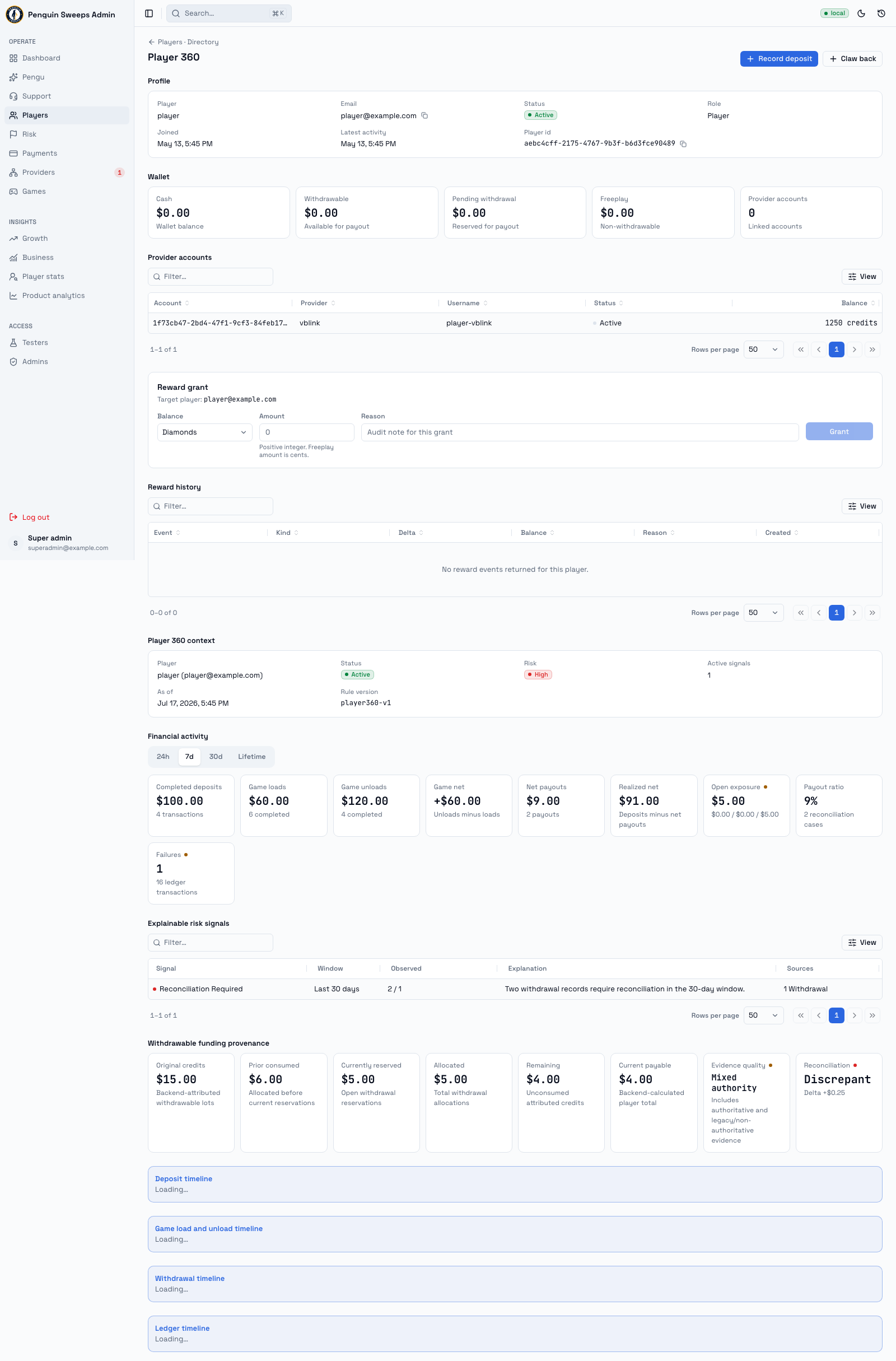
Get the basics. Profile, account status, what's in the wallet, their provider accounts, and their reward history. This is usually where the answer already starts to appear.
-
Widen out (super admins). Pick a time window —
24h,7d,30d, orLifetime— and look through the risk signals, deposits, transfers, cash-outs, and ledger timeline. Start narrow and widen if you need to. -
Open the actual record. If a deposit looks wrong, open that deposit. Don't work it out from the balance. Balances are the end of a story; the record tells you the story.
-
Put it in time order. Write out what happened when:
- what the player did
- what the payment or provider did
- what happened to the wallet and rewards
- what support told them
Nine times out of ten, the gap in the timeline is the answer. And once it's written in order, anyone can check your reasoning.
-
Write your conclusion. Four things: what you know, what you still don't know, what this means for the player, and who should pick it up next.
That fourth one matters. "Handing over with unknowns clearly marked" is a good outcome. "Guessing to avoid handing over" isn't.
The four things you'll usually be chasing
"My deposit never showed up." Compare the deposit's status and events against what actually hit the wallet. A receipt from the player proves they sent money. It doesn't prove it settled on our side. Those are different things, and the gap between them is usually the whole issue.
"Where's my cash out?" Look at the cash-out's status, the proof, the provider reference, and where the money came from — all of it, before anyone touches a button. See A player wants to be paid out.
"The game took my money." Compare their provider account and transfer status against provider health and the reconciliation queue. If the provider was having a bad hour, that's often the whole story.
"I didn't get my bonus." Check the reward history against the deposit or event that should have triggered it. Confirm the reward is genuinely missing before granting anything — granting a reward that was already given is very hard to spot later.
Stop and ask for help when
- The identities don't line up, or you're being asked for information about someone unconnected to the case.
- The ledger, the payment, and the provider all say different things.
- The evidence is old, unavailable, or the outcome is genuinely unknown.
- The only fix you can think of isn't available as a button in the tool. That's a strong signal it needs engineering, not a workaround.
Write these down
Player ID, why you were looking and the ticket reference, the time window, the related record/event/ledger IDs, your name, and a short conclusion in your own words.
Don't copy across passwords, card numbers, raw technical payloads, or personal details the case doesn't need. Take what answers the question and leave the rest where it is.